
কনটেন্টটি শেষ হাল-নাগাদ করা হয়েছে: বুধবার, ২৯ জুলাই, ২০২৬ এ ১০:৩৬ PM
The Government of Bangladesh and UNICEF signed a landmark agreement to expand access to education and skills development for thousands of out-of-school children and young people.
কন্টেন্ট: খবর প্রকাশের তারিখ: ২৯-০৭-২০২৬ আর্কাইভ তারিখ: ৩১-০৮-২০২৬
Government of the People’s Republic of Bangladesh
Ministry of Finance
Economic Relations Division
PRESS RELEASE
Dhaka | 29 July 2026
Government of Bangladesh and UNICEF Launch National Initiative to Expand Learning Opportunities for Out-of-School Children
Partnership to provide quality education and market-relevant skills to 38,400 children and young people across Bangladesh.
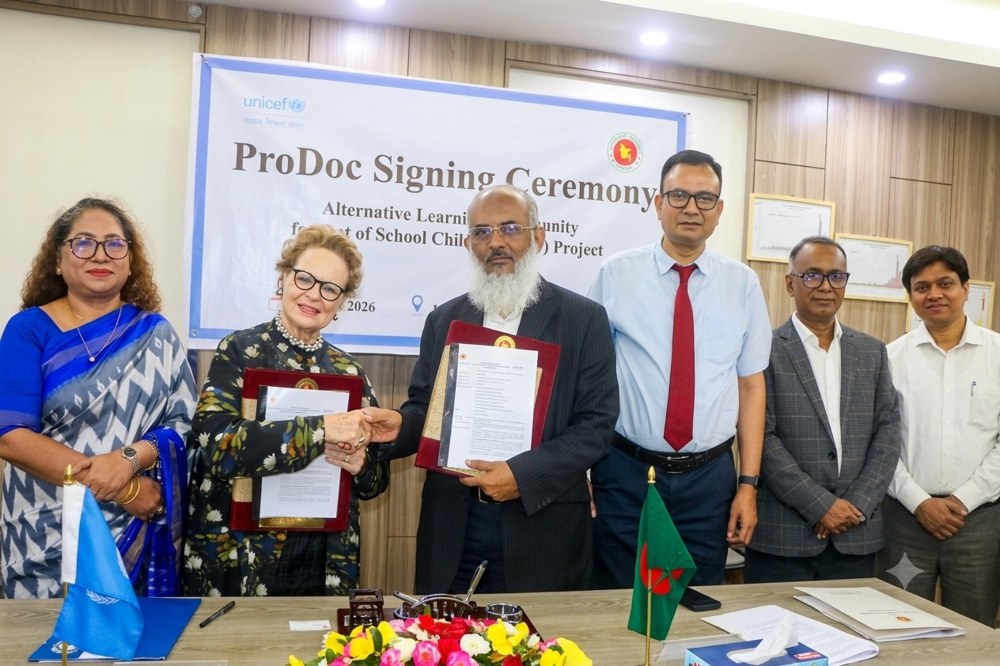
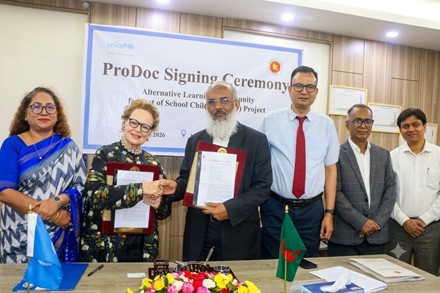
Representatives of the Government of Bangladesh and UNICEF at the signing of the ALO Project document at ERD, Dhaka, on 29 July 2026.
The Government of Bangladesh and UNICEF today signed a landmark agreement to expand access to education and skills development for thousands of out-of-school children and young people, reaffirming their shared commitment to ensuring that every child has the opportunity to learn, thrive and contribute to the nation’s future.
The project, titled “Alternative Learning Opportunities for Out-of-School Children (ALO),” was signed at the Economic Relations Division (ERD), Ministry of Finance, in Dhaka.
The agreement was signed on behalf of the Government of Bangladesh by Mr. Md. Shahriar Kader Siddiky, Secretary, Economic Relations Division, and on behalf of UNICEF by Ms. Gillian Mellsop, Representative a.i., UNICEF Bangladesh. The signing ceremony was conducted by Mr. A K M Sohel, Additional Secretary and Wing Chief (UN), Economic Relations Division, who delivered the opening remarks.
Senior representatives from the Economic Relations Division, the Ministry of Primary and Mass Education (MoPME), the Bureau of Non-Formal Education (BNFE), and UNICEF Bangladesh attended the ceremony.
The ALO project seeks to provide a second chance for children who have dropped out of formal education while equipping disadvantaged young people with practical, market-oriented skills that enhance their employability and economic resilience.
Over the three-year implementation period (2026–2028), the initiative will support 38,400 learners, including:
19,200 children aged 10–14 through alternative basic education programmes; and
19,200 young people aged 15–24 through market-driven vocational and employability skills training.
The programme aims to ensure that at least 60 percent of participating youth transition into wage employment or self-employment, helping them build sustainable livelihoods.
The project will be implemented by the Bureau of Non-Formal Education (BNFE) under the Ministry of Primary and Mass Education (MoPME) through 960 learning centres across 64 upazilas nationwide.
With a total investment of approximately BDT 1.587 billion (Tk 158.74 crore), the initiative is financed primarily by the Government of Bangladesh, which will contribute nearly 93 percent of the project cost. UNICEF will provide a technical assistance grant of approximately BDT 117 million, supporting programme design, implementation and quality assurance.
The ALO initiative builds upon the successful SKILFO pilot programme, under which 82 percent of graduates secured decent employment, demonstrating the effectiveness of integrated education and skills development interventions.
The project directly contributes to the achievement of Sustainable Development Goal (SDG) 4 – Quality Education, while also advancing Bangladesh’s commitment to the principle of “Leaving No One Behind.” By re-engaging children in education and creating pathways to productive employment, the initiative is expected to help reduce child labour, discourage early marriage, and strengthen social inclusion.
Speaking at the ceremony, Mr. Md. Shahriar Kader Siddiky, Secretary, Economic Relations Division, reaffirmed the Government’s commitment to ensuring that every child has equitable access to quality education and opportunities to realise their full potential.
Ms. Gillian Mellsop, Representative a.i., UNICEF Bangladesh, noted that the partnership reflects the shared commitment of UNICEF and the Government of Bangladesh to building an inclusive education system that empowers vulnerable children and young people with the knowledge and skills they need for a brighter future.
UNICEF has been a longstanding development partner of Bangladesh, supporting national efforts in education, health, nutrition, water, sanitation, child protection and social development. The ALO project represents another important milestone in this enduring partnership to advance inclusive and equitable development for the children and young people of Bangladesh.
Issued by
United Nations Wing, Economic Relations Division, Ministry of Finance
Government of the People’s Republic of Bangladesh · Sher-e-Bangla Nagar, Dhaka-1207 · www.erd.gov.bd

Md. Assadekjaman
Senior Assistant Secretary, ERD